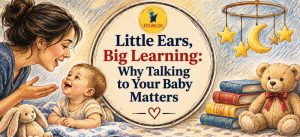
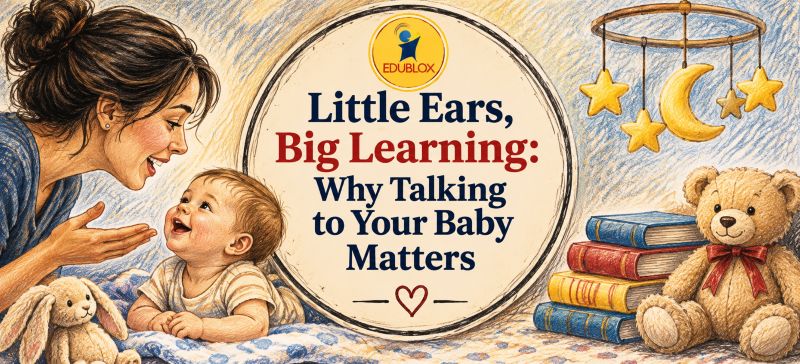
Long before your baby utters that eagerly awaited first word, an extraordinary learning process is already underway. From the familiar sound of a parent’s voice to the rhythm of a nursery rhyme and the repeated telling of a favourite story, everyday language experiences help shape the foundations of communication, thinking, and later learning. The wonderful thing is that parents don’t need expensive educational toys or elaborate stimulation programmes to encourage this development. Some of the most valuable learning opportunities are already part of ordinary family life.
Language learning begins before birth
Imagine being able to tell whether a newborn baby was French or German simply by listening to the way the baby cried. It sounds improbable, yet researchers discovered something remarkably close to this in a study published in Current Biology in 2009.
The researchers analysed the crying melodies of French and German newborns and found that the two groups showed different patterns. French babies tended to produce cries with rising melodies, while German babies more frequently produced falling melodies, reflecting characteristic differences in the intonation of their respective languages. These findings suggested that babies had already become familiar with certain sound patterns of their native language before they were born.
During the final months of pregnancy, babies can hear sounds from outside the womb, although these are muffled and the finer details of speech are difficult to distinguish. The rhythm and melody of a mother’s voice, however, are sufficiently prominent for the developing baby to become familiar with them. By the time a baby enters the world, the foundations of language learning have therefore already been laid.
This doesn’t mean that expectant mothers should feel obliged to play recordings of Mozart or invest in prenatal language programmes. Ordinary conversation, singing, and the familiar sound of a parent’s voice provide opportunities for babies to become acquainted with the rhythms of speech.
Why language is so important for learning
When we think about language development, we naturally think about children learning to communicate their needs, express their feelings, and eventually hold conversations. Yet language serves another important purpose: it helps children organise their experiences, develop concepts, remember information, and make sense of the world around them.
Consider how a young child learns the meaning of big and small. Initially, these words may be associated with two familiar toys, but as the child encounters them in different situations, the concepts become increasingly flexible. A big dog may be small compared with a horse, while a small tree may be enormous compared with a flower. Through repeated exposure and experience, children gradually learn to apply concepts beyond the situations in which they first encountered them.
Language and thinking are closely connected, and their development can reinforce one another. As children’s vocabularies expand, they acquire additional tools for describing relationships, comparing objects, asking questions, and explaining their reasoning. These abilities become increasingly important when children enter school, where much of what they learn depends on understanding spoken explanations, following instructions, interpreting written information, and expressing ideas.
Language development therefore deserves at least as much attention as the more visible milestones of early childhood, such as sitting, crawling, and walking. Although children develop at different rates and a late talker will not necessarily experience learning difficulties, persistent language delays are associated with an increased risk of later reading and academic problems. Parents who are concerned about their child’s language development should seek professional advice rather than simply assume that the child will eventually catch up.
Conversations begin long before the first word
Anyone who has spent time with a happy, babbling baby will know that babies are enthusiastic conversationalists, even when nobody understands a word they are saying. A baby may produce a delighted string of sounds, pause while an adult responds, and then continue with another enthusiastic contribution. Although these exchanges may seem like little more than an amusing game, they introduce the child to one of the fundamental principles of communication: conversation involves taking turns.
Researchers refer to these back-and-forth exchanges as conversational turns, and evidence suggests that they are important for language development. In a 2018 study, Rachel Romeo and her colleagues examined the relationship between children’s language experiences, their language abilities, and brain activity in areas involved in language processing. The researchers found that the number of conversational turns children experienced was associated with their language skills and language-related brain function.
The study involved children aged four to six, so it would be incorrect to assume that the findings apply directly to newborn babies. Nevertheless, the research highlights an important distinction between simply exposing children to words and actively engaging them in communication. Hearing language matters, but opportunities to respond, participate, and influence the direction of a conversation are also valuable.
Parents can encourage these exchanges from the earliest months. When a baby makes a sound, respond with a smile, a few words, or a playful imitation, and then pause to allow another response. As children grow older, conversations can become more elaborate. If a toddler points at a dog and says, “Dog run,” a parent might reply, “Yes, that big brown dog is running very fast!” The child hears familiar words used in a longer sentence and encounters new vocabulary without being interrupted or formally corrected.
These everyday exchanges require no special equipment or preparation, and they can take place while feeding, dressing, bathing, or playing with a child. What matters is not maintaining a constant stream of words but responding naturally and giving the child opportunities to participate.
Repetition: The secret behind so much early learning
Parents sometimes worry that they are repeating themselves too often, particularly when their conversations with a baby seem to revolve around the same handful of objects and activities. Yet repetition is one of the most important principles of learning, and young children benefit enormously from encountering familiar words and experiences again and again.
When a baby first hears the word bottle, it may be nothing more than an unfamiliar sequence of sounds. As the word is repeatedly used during feeding, however, the child begins to associate it with a particular object and experience. Eventually, the baby may look toward the bottle when someone mentions it, even though producing the word independently may still be some way off.
This illustrates the difference between receptive language, which refers to the words and sentences a child understands, and expressive language, which refers to the language a child can produce. Understanding generally develops ahead of speaking, and a baby who says very little may already understand considerably more than parents realise.
Repetition also allows existing knowledge to be extended. During bath time, for example, parents may repeatedly name familiar objects such as the soap, towel, water, and washcloth. Once these words become familiar, descriptions such as warm water, soft towel, and wet washcloth introduce additional vocabulary and concepts. Later, the same routine provides opportunities to discuss why objects float or sink, what happens when water is poured from one container into another, and why a wet towel eventually becomes dry.
In this way, repeated experiences provide a familiar foundation on which increasingly complex language and understanding can develop. Repetition does not mean mechanically drilling words into a child or insisting that every word be repeated a particular number of times. Rather, it involves giving children many opportunities to encounter and use language in meaningful situations.
One of the clearest examples of the power of repetition can be found in children’s seemingly endless enthusiasm for hearing the same stories.
Why children love hearing the same story again and again
Most parents have experienced the peculiar frustration of finishing a bedtime story, only to have their child immediately demand that it be read again. After the fifth or sixth reading, the parent may be thoroughly tired of the story, while the child remains as delighted as ever. Fortunately, research suggests that this enthusiasm for repetition serves a valuable learning purpose.
In a 2011 study, Jessica Horst, Kelly Parsons, and Natasha Bryan investigated how repeated storybook reading influenced vocabulary learning in three-year-old children. Some children repeatedly heard the same stories, while others heard different stories containing the same unfamiliar target words. The researchers found that children who repeatedly heard the same stories were more successful at learning the new words.
One possible explanation is that an unfamiliar story places considerable demands on a young child’s attention. The child must become acquainted with the characters, follow the events, interpret the pictures, and make sense of unfamiliar vocabulary. When the story is repeated, much of this information is already familiar, allowing the child to pay greater attention to particular words and details. Repeated exposure also provides further opportunities to strengthen associations between words and their meanings.
Parents can often observe this learning process for themselves. A child who initially listens quietly may begin to anticipate familiar phrases, complete sentences, or correct an adult who accidentally changes a word. As the story becomes increasingly familiar, the child may also remember the sequence of events and begin to understand relationships that were not obvious during the first reading.
Repeated storybook reading can therefore provide opportunities to develop vocabulary, memory, sequencing, and comprehension. Parents can extend these benefits by occasionally discussing the pictures, asking what happened earlier in the story, or encouraging the child to predict what might happen next. The questions should, of course, suit the child’s age and language abilities, and reading should remain an enjoyable shared experience rather than becoming a test.
Books offer another important advantage: they introduce children to words and sentence structures that may not feature prominently in everyday conversation. A story about a forest might include words such as enormous, whispered, discovered, or disappeared, while a story about animals may introduce unfamiliar habitats, behaviours, and relationships. Through repeated readings and conversations, children gradually become familiar with language and concepts that extend beyond their immediate surroundings.
There is consequently no need to rush through an ever-growing collection of books in the belief that variety is always better. New stories certainly have their place, but familiar favourites deserve to be enjoyed repeatedly. What feels like unnecessary repetition to an adult may be exactly what a child needs to consolidate learning.
Why we instinctively speak differently to babies
Adults often change the way they speak when addressing babies, using a slightly higher pitch, slower pace, and more expressive intonation. This distinctive style of speech, known as parentese, appears across many cultures and has attracted considerable scientific interest.
Parentese should not be confused with replacing ordinary words with meaningless sounds. It involves using real language in an expressive, engaging manner, often with elongated vowels, exaggerated intonation, and pauses that make it easier for babies to attend to speech.
In research published in 2020, Naja Ferjan Ramírez and colleagues investigated whether coaching parents to use parentese and encourage conversational turns could influence infant language development. Their findings indicated that this approach increased parent-child conversational interactions and was associated with advances in early language development.
The practical implications are encouraging because parents do not need to master a complicated technique. Speaking warmly and expressively, following a baby’s interests, and allowing opportunities for responses can all contribute to a stimulating language environment.
Singing nursery rhymes and familiar songs provides another enjoyable way to expose children to language. Rhythm, rhyme, and repeated sound patterns draw attention to the sounds of speech, while accompanying actions and gestures can help children connect words with meaning. As children grow older, their increasing awareness of sounds and rhymes contributes to the broader development of phonological awareness, which is important for learning to read.
From babbling to meaningful sentences
During the first year of life, babies communicate through crying, facial expressions, eye contact, gestures, and an increasingly varied range of sounds. Babbling gradually becomes more complex, and many children begin using their first meaningful words around their first birthday, although there is considerable variation in the timing of these milestones.
At first, a single word may communicate an entire message. A baby reaching towards a bottle and saying “bottle” may be asking for a drink, while an excited “Daddy!” could mean that Daddy has arrived, that Daddy is wanted, or that something interesting has happened involving Daddy. The meaning becomes clear through the situation, the child’s gestures, and the adult’s response.
During the second year, many children’s vocabularies expand and they begin combining words into short expressions such as “more milk,” “Mommy gone,” or “big car.” These early combinations gradually develop into longer sentences as children acquire additional vocabulary and become more familiar with the patterns of their language.
Although these stages provide useful guidelines, they should not be treated as rigid deadlines. Some children begin speaking earlier than others, and differences in developmental pace are not automatically a cause for concern. Nevertheless, a child who responds very little to sound, shows limited understanding of language, does not develop meaningful gestures, or loses previously acquired language skills should be assessed by an appropriate professional. Hearing difficulties and other developmental concerns are important to identify as early as possible.
Can talking to your baby make them smarter?
The relationship between language and intelligence is fascinating, partly because language is involved in so many aspects of thinking and learning. Children use words to classify objects, describe relationships, remember experiences, solve problems, and communicate their reasoning. As their language develops, they gain increasingly sophisticated ways of understanding and expressing ideas.
It would, however, be misleading to suggest that the number of words parents speak to their babies directly determines their intelligence. Cognitive development is influenced by numerous interacting factors, and research showing an association between language experiences and later abilities does not necessarily establish that one causes the other.
What we can say is that rich, responsive language experiences provide valuable opportunities for children to develop vocabulary, knowledge, communication skills, and understanding. These abilities become increasingly important as children progress through school, particularly when they are expected to understand complex instructions, learn from explanations, and interpret written material.
The relationship between oral language and reading comprehension is especially important. Learning to read involves more than recognising printed words. Children must also understand the language represented by those words, including vocabulary, sentence structure, and the ideas being communicated.
A child may learn to decode words accurately yet struggle to understand a passage containing unfamiliar vocabulary or concepts. Conversely, a strong foundation in spoken language can support the development of reading comprehension, although it does not eliminate the possibility of reading difficulties.
Early language stimulation should therefore not be viewed as a guarantee of higher intelligence or future academic success. Its value lies in helping children develop important abilities that contribute to learning throughout childhood and beyond.
Do babies need educational videos and expensive toys?
Modern parents are presented with an extraordinary range of products promising to stimulate brain development, accelerate learning, or give children an educational advantage. Although some toys and digital resources can encourage exploration and shared play, they are no substitute for responsive human interaction.
Consider the difference between a baby watching a recording that repeatedly names animals and a parent talking about a dog that has just wandered into the garden. The parent can notice where the baby is looking, respond to excitement or curiosity, describe the dog’s movements, and adapt the conversation to whatever captures the child’s attention. A recording may provide repeated exposure to words, but it cannot respond to a baby’s changing interests in the same spontaneous way.
This is not an argument against every educational toy or digital resource, but rather a reminder that their value should be considered in relation to the child’s age, developmental needs, and opportunities for interaction. The American Academy of Pediatrics has emphasised the importance of early literacy experiences, including shared reading, as part of children’s healthy development.
Fortunately, parents do not need to schedule formal language lessons for their babies or turn every activity into an educational exercise. Daily routines already provide a wealth of opportunities to introduce words, reinforce familiar concepts, and enjoy conversations. Preparing a meal, folding laundry, walking through a garden, or getting ready for bed can all become occasions for language learning, particularly when adults respond to what interests the child.
A gift that costs nothing
Parents naturally want to give their children the best possible start in life, and it is tempting to believe that this requires specialised educational materials or carefully planned stimulation programmes. Yet some of the most valuable early learning experiences are wonderfully ordinary: a familiar voice during feeding, a playful conversation at bath time, a nursery rhyme sung for the hundredth time, or a favourite bedtime story that everyone in the family knows by heart.
These experiences do more than introduce children to individual words. They provide opportunities to develop communication, understanding, memory, and knowledge while strengthening the relationships through which much early learning takes place.
No amount of talking or reading can guarantee that a child will never experience a language or learning difficulty, and parents should not feel that every quiet moment represents a missed opportunity. Children also need time to explore, play independently, and simply enjoy being children.
What matters is the richness and responsiveness of the interactions that form part of everyday life. By talking with their babies, listening to their attempts to communicate, singing familiar songs, and reading stories repeatedly, parents can help establish a foundation for language and learning that will continue to develop long after those first words have been spoken.
And when your toddler asks for that same bedtime story yet again, you can take comfort in knowing that the repetition you find so tiresome may be helping your child learn something new.
Research references:
- American Academy of Pediatrics. (2024). Literacy Promotion: An Essential Component of Primary Care Pediatric Practice: Policy Statement. Pediatrics, 154(6), e2024069090. https://doi.org/10.1542/peds.2024-069090
- Ferjan Ramírez, N., Lytle, S. R., & Kuhl, P. K. (2020). Parent coaching increases conversational turns and advances infant language development. Proceedings of the National Academy of Sciences, 117(7), 3484–3491. https://doi.org/10.1073/pnas.1921653117
- Horst, J. S., Parsons, K. L., & Bryan, N. M. (2011). Get the Story Straight: Contextual Repetition Promotes Word Learning from Storybooks. Frontiers in Psychology, 2, 17. https://doi.org/10.3389/fpsyg.2011.00017
- Mampe, B., Friederici, A. D., Christophe, A., & Wermke, K. (2009). Newborns’ Cry Melody Is Shaped by Their Native Language. Current Biology, 19(23), 1994–1997. https://doi.org/10.1016/j.cub.2009.09.064
- Romeo, R. R., et al. (2018). Beyond the 30-Million-Word Gap: Children’s Conversational Exposure Is Associated With Language-Related Brain Function. Psychological Science, 29(5), 700–710. https://doi.org/10.1177/0956797617742725