Reading comprehension is the heart and goal of reading since the purpose of all reading is to gather meaning from the printed page. It is assumed that the comprehension of children who are good readers is on track. But three to ten percent of those children don’t understand most of what they’re reading.
There may be other causes, but these are the most common causes of a reading comprehension problem:
1. Poor vocabulary
Vocabulary is essential for reading success. Students cannot understand what they read without understanding what most of the words mean. Decades of research have confirmed vocabulary’s important role in reading comprehension and students’ overall academic success.
2. Poor memory skills
Researchers have been able to pinpoint brain activity and understand its role in reading disabilities, but until recently, no functional magnetic resonance imaging or fMRI studies have examined the neurobiological profile of those who exhibit poor reading comprehension despite intact word-level abilities.
Neuro-imaging of children showed that, while reading, the brain function of those with reading comprehension problems is quite different and distinct from those with reading disabilities. Those with reading disabilities exhibited abnormalities in a specific region in the occipital-temporal cortex, a part of the brain associated with successfully recognising words on a page. On the other hand, those with reading comprehension problems did not show abnormalities in this region; instead, they showed specific abnormalities in areas typically associated with memory.
That there will be defects in the brain areas concerned with memory makes sense. Several studies have confirmed that reading comprehension relies heavily upon working and long-term memory.
Short-term memory holds information in the mind for only a few seconds while it is being processed. Long-term memory is where such processed information is permanently stored. Working memory is an intermediary and active memory system in the information-processing area of the brain. It is a crucial memory system that most of us use every day.
Sentence comprehension depends heavily upon adequate working memory. For example, working memory is required to comprehend sentences that are complex in structure, such as, “The clown that is hugging the boy is kissing the girl.” It helps us interpret lengthy sentences, “Do every other problem on page fifteen and all of the problems on page sixteen before checking your answers in the back of the book.” We use working memory when preservation of word order (syntax) is important to correctly understand a sentence like, “It was the boy’s ball and not the girl’s that was dirty.”
3. Poor logical thinking skills
Logical thinking is the process in which one uses reasoning consistently to conclude. Problems or situations involving logical thinking call for structure, relationships between facts, and chains of reasoning that “make sense.”
The relationship between logical thinking and reading is well-established in the literature. It has been said that “there is no reading without reasoning,” and even that reading is reasoning.
From theory to practice
To improve a child’s vocabulary, make little word cards with the word on the front and the definition on the reverse. For example, if the word “archipelago” is on the front, the explanation “a group of islands” will be on the reverse. Let your child start by studying five word cards; add five new word cards to the pile every time they know the meaning of the words. Regularly review and test old word cards.
Contact your closest Edublox clinic for an assessment and help if you consider memory a deficit. Edublox clinics also provide training in logical thinking processes.
Besides being important for reading comprehension, it has been proven that specific training in logical thinking processes can make people “smarter.” Logical thinking allows children to reject quick answers, such as “I don’t know” or “This is too difficult,” by empowering them to delve deeper into their thinking processes and better understand the methods used to arrive at a solution and even the solution itself.
Practising logical thinking
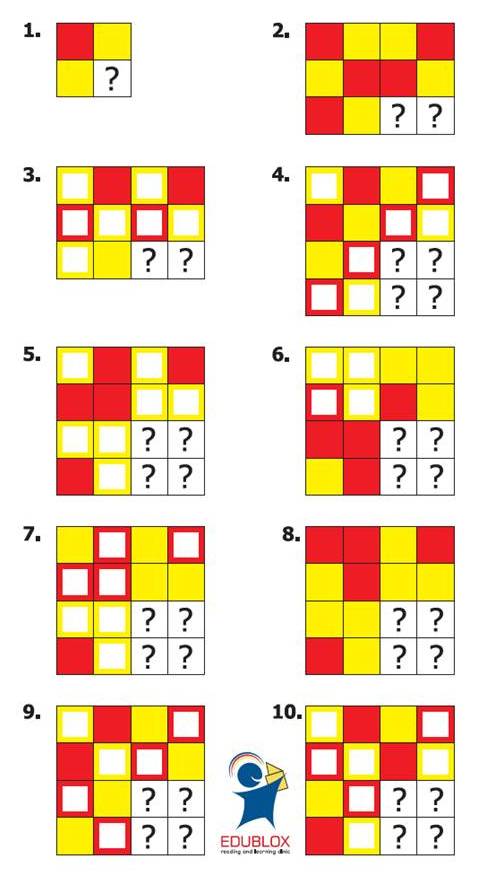
Print the quiz below. Using a red and yellow pencil, your child must replace the question marks with either a solid yellow, solid red, yellow border or red border.
 Answers