

When talking about learning difficulties, many people assume that we are referring to reading difficulties. We often hear the saying, “A learning problem is a reading problem.” This, of course, is not true. Among learners with learning difficulties, mathematics difficulties are just as common as reading problems. In the Journal of Learning Disabilities, McLeod and Crump reported that approximately half of learners with learning difficulties require additional support in mathematics.
In today’s world, mathematical knowledge, reasoning, and problem-solving skills are just as important as the ability to read. Whether in science, business, technology, or everyday life, we cannot escape the use of numbers. Every occupation, from a rocket scientist to a sheep farmer, requires mathematics. Regardless of the country you live in or the language you speak, mathematics is an essential life skill.
So how do we help a child with mathematics learning difficulties? Since successful intervention depends on identifying the cause or causes of a problem, finding the cause is our starting point. We must therefore ask, “What causes mathematics difficulties?”
Mathematics consists of three aspects
1. Foundational skills
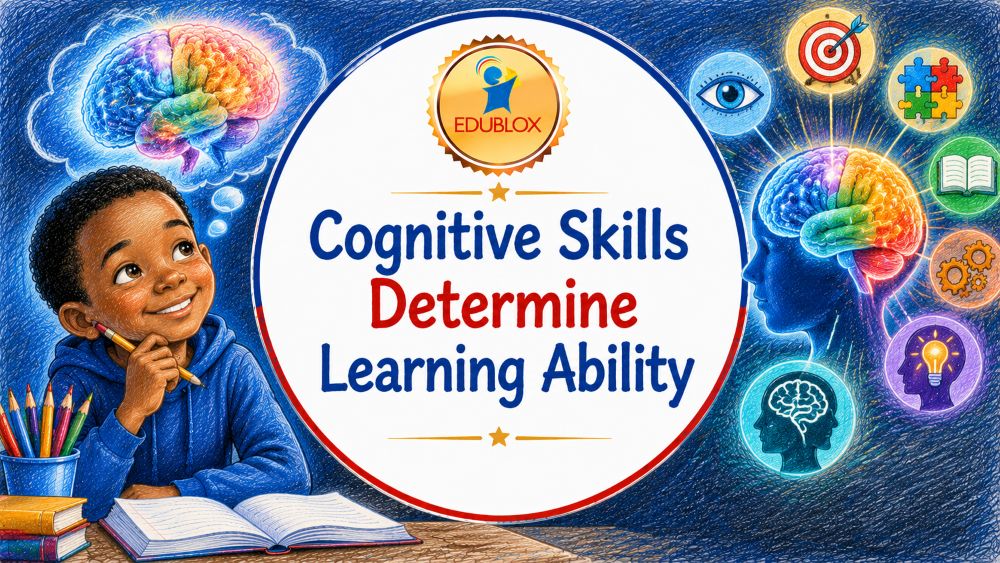
Research has shown that focused, sustained, and divided attention; visual perception; sequential and working memory; and logical thinking are among the most important foundational skills for mathematics.
Visual perception refers to the ability to interpret and organise visual information. It includes skills such as visual discrimination and visual memory. Visual discrimination is the ability to identify the distinguishing features of objects, such as their shape, orientation, colour, and size. Visual memory refers to the ability to remember visual information.
One hundred and seventy-one children with a mean age of 10.08 years participated in a study by Marjean Kulp and colleagues at the Ohio State University College of Optometry. The study investigated whether performance on visual perception tests could predict poor achievement in mathematics.
Kulp and colleagues concluded that poor visual perceptual ability, particularly visual memory, is significantly associated with poor achievement in mathematics.
2. Mathematical skills
There are many mathematical skills that learners must master, including counting, addition, subtraction, multiplication, and division.
The first step is to ensure that a child can count fluently, forwards and backwards. Thereafter, skip counting should be introduced. Skip counting is essential for developing number sense and calculation fluency and forms the foundation for multiplication and division.
It is also important to help learners move from calculating by counting in ones to using number facts automatically. For example, instead of working out 12 + 4 by counting 12, 13, 14, 15, and 16, learners should immediately know to add four, or perhaps add two twice. This transition to fluent recall of number facts is a key to later success in mathematics.
3. Knowledge
There is also much in mathematics that learners simply have to know, including mathematical terms, definitions, symbols, theorems, and axioms. These are facts that must be learned, not skills that have to be performed.
A child who does not know what a sphere is will have to guess when presented with twelve objects and asked, “Which of the above objects have the same shape as a sphere?”
Learning is a step-by-step process
Learning mathematics is a sequential process. Certain skills must first be mastered before it becomes possible to master more advanced skills.
To become a rugby player, a person must first master the foundational skills, such as passing, kicking, and tackling. In the same way, a child must first develop the foundational skills required for mathematics, such as visual perception and logical thinking.
The second step is to master mathematical skills in the correct sequence. A child must learn to count before learning to add and subtract. Suppose someone tried to teach a child who had not yet learned to count to add and subtract. This would be impossible. No amount of effort would succeed because the necessary foundation has not yet been laid.
The final step is to ensure that the learner catches up in the knowledge component of mathematics.
Mathblox classes
Mathblox classes, offered at Edublox clinics, are aimed at Grade 2 to Grade 7 learners and lay the foundation for success in mathematics. We achieve this by teaching your child:
- An in-depth understanding of the terminology used in mathematics.
- The foundational cognitive skills that support mathematics, including focused, sustained, and divided attention; visual perception; sequential and working memory; and logical thinking.
- Application through curriculum-based exercises, including mental arithmetic, telling the time, word problems, and much more.
Classes are offered in English and Afrikaans. Contact us to find out more.
A testimonial
Gina Hartoog shares how Mathblox helped her son thrive in mathematics:
“During the third and fourth terms of Grade 2, my son did very poorly in maths. His confidence took a knock and he became very emotional and anxious when it came to written tests. We decided to put him in Edublox and Mathblox classes for Grade 3.
“Within six weeks, I noticed a huge difference in him. His confidence grew amazingly and the tears stopped! He was quite simply – a different child! In his first written Maths test for Grade 3 he got 77% – the second highest in his class.“
Click here for 800+ success stories.

2 Responses
Goeie dag my dogter in graad 4 sukkel vreeslik met wiskunde sy het laasjaar heeljaar remidiering gedoen wat n bietjie gehelp het – kan julle asb vir my meer inligting gee rakende klasse en die koste daaraan verbonde. Ek het ook iewers gelees van aanlyn klasse want sy doen gimnastiek en oefen die elke middag behalwe op n Vrydag. Ons woon in Klapmuts naby die Paarl.
Hello Lieza
Die verskil tussen Edublox en remediëring is dat Edublox fokus op die kognitiewe vaardighede wat Wiskunde ondersteun, soos verdeelde aandag, visuele prosessering, visuele en werkende geheue, en logiese denke. Edublox is nie ‘n kitsoplossing nie, maar wel ‘n permanente oplossing.
Die Edublox Math Tutor gaan nog lank neem om te voltooi, daarom is jou beste opsie om Louna in die Paarl te kontak vir Mathblox-klasse. Sy sal al die kostes aan jou verduidelik. Hier is haar kontakbesonderhede:
Tel: (021) 872-5040; Cell: 072-510-2986; Email: louna@edublox.com
Address: 9 Dorp Street, Paarl
Groete
Susan