The word cognition refers to the act or process of knowing. Cognitive skills, therefore, are the mental skills that make learning, thinking, reasoning, and understanding possible. These skills form the foundation of successful learning.
Human beings are not born knowing how to read, write, solve mathematics problems, or reason logically. Apart from natural body functions such as breathing and reflexes, everything we know and can do must be learned. Cognitive skills are therefore learned skills that can be developed and strengthened through teaching, practice, and experience.
Concentration
Attention and concentration are often confused, but they are not exactly the same.
Attention is usually automatic and short-lived. A child may notice sounds, movement, or something visually interesting for a few moments, but their focus quickly shifts elsewhere. Concentration, on the other hand, involves deliberately focusing attention on a task and sustaining that focus over time.
Concentration is essential for successful learning. Learners need it to listen to explanations, complete tasks, follow instructions, solve problems, and remember information.
Concentration does not simply appear on its own. Like other cognitive skills, it develops gradually and improves with structured practice and repetition. As concentration improves, learners are often able to work more efficiently, make fewer careless mistakes, and complete tasks with greater confidence.
Perception
The terms processing and perception are often used interchangeably.
Before learning can occur, perception must take place. A learner first has to become aware of information through the senses — usually by seeing or hearing it — and then interpret what was seen or heard.
In essence, perception involves interpretation. Two people may observe the same situation but interpret it differently because perception is influenced by previous knowledge and experience. Philosopher Immanuel Kant expressed this idea well when he wrote:
“We see things not as they are but as we are.”

A simple example illustrates this principle. Imagine walking away from your parked car while continuing to look back at it. As the distance increases, the car appears smaller and smaller. Yet nobody panics and thinks the car is actually shrinking. Past experience has taught us that objects do not change size simply because we move farther away from them.
Perception, therefore, depends heavily on previous experience and practice. This means perceptual abilities can often be strengthened through systematic training and repeated exposure to carefully structured activities.
Perceptual skills involved in learning include:
- visual discrimination,
- auditory discrimination,
- figure-ground perception,
- spatial awareness,
- visual and auditory analysis,
- and synthesis skills.
These abilities are important for reading, spelling, writing, comprehension, and mathematics.
Memory
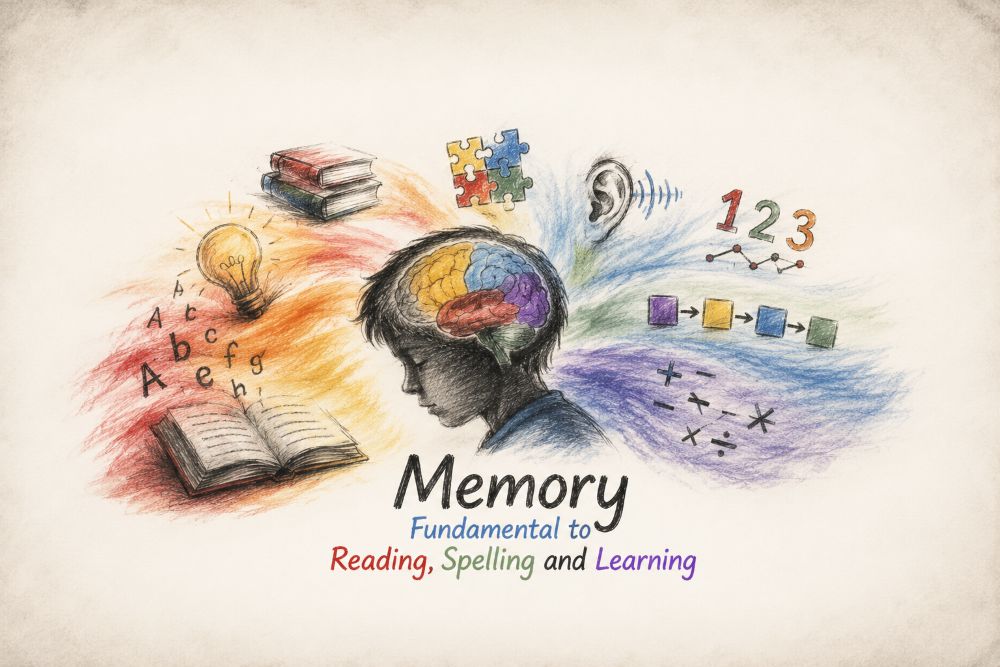
Many learners who struggle academically also experience weaknesses in different types of memory.

Receptive memory
Receptive memory is the ability to recognize information previously encountered. A learner with receptive memory difficulties may struggle to consistently recognize letters, words, sounds, or number symbols.
Sequential memory
Sequential memory refers to the ability to remember information in the correct order.
This skill is especially important for reading and spelling because words consist of letters arranged in a precise sequence. Changing the sequence of letters changes the meaning entirely. For example:
- name
- mean
- amen
all contain the same letters, yet the sequence changes the word completely.
Weak visual sequential memory may therefore affect reading and spelling accuracy. Weak auditory sequential memory may cause learners to mix up syllables or struggle to repeat longer words correctly.
Rote memory
Rote memory refers to the ability to store and recall information automatically. Learners rely on rote memory to remember:
- the alphabet,
- multiplication tables,
- spelling rules,
- grammar rules,
- and mathematical facts.
When rote memory is weak, learning often becomes slow and effortful because information never becomes automatic.
Short-term and working memory
Short-term and working memory allow us to hold and manipulate information briefly while performing a task.
For example, when solving a mathematics problem mentally, learners must temporarily remember one step while completing the next. Working memory is also needed for reading comprehension, writing, following instructions, and problem-solving.
Weak working memory often causes learners to lose track of information, forget instructions, or struggle with multi-step tasks.
Long-term memory
Long-term memory refers to the ability to store and retrieve information learned in the past.
Without effective long-term memory, learners may repeatedly forget previously learned work and feel as if every lesson is completely new. This can make academic progress slow and frustrating.
Memory is universally recognized as essential for successful learning, yet relatively little attention is often given to systematically improving memory skills.
Logical thinking

Logical thinking is not a mysterious talent or simply a matter of natural intelligence. It is a learned cognitive process that develops over time.
Logical thinking involves using reasoning consistently to arrive at conclusions that make sense. It allows learners to recognize relationships, organize information, solve problems, and think step-by-step.
According to Dr. Karl Albrecht in his book Brain Building, the basis of logical thinking is sequential thought — the ability to arrange facts and ideas in a meaningful order.
Logical thinking is particularly important in mathematics because it is highly sequential. One concept often depends upon understanding previous concepts first. For example:
- fractions depend on understanding division,
- algebra depends on understanding fractions,
- and solving word problems depends on understanding equations.
Research suggests that targeted training in logical thinking can improve reasoning and problem-solving abilities. Logical thinking also helps learners move beyond quick responses such as “I don’t know” or “This is too difficult,” encouraging deeper, more organized thinking.
Why cognitive skills matter
Cognitive skills form the foundation of learning. When these foundational skills are weak, learners often struggle academically despite effort and motivation.
Strengthening cognitive skills may help learners:
- concentrate better,
- process information more accurately,
- remember information more effectively,
- reason logically,
- and learn with greater confidence and efficiency.
How Edublox helps
Edublox clinics specialize in cognitive training designed to improve learning readiness and help learners learn more effectively.
The classes focus on developing:
- concentration,
- perceptual skills,
- memory,
- logical thinking,
- reading,
- spelling,
- vocabulary,
- and comprehension.
Through structured cognitive training and systematic practice, learners can strengthen the foundational skills required for successful learning.
Contact your closest Edublox branch for a cognitive skills evaluation and help.